

ISSUE #035 | THE LEADERSHIP CONTRARIAN
I can't remember his name.
I remember his face. I remember the way he stood at the front of that room like there was nowhere else he'd rather be. And I remember that he didn't care how many chairs he had.
The class was a requirement. Modern History, mid-1800s forward. Most professors teaching a required class cap it. Once the seats are full, you wait for another semester or take your chances with whoever else is open. Not him. He let in every student who wanted his section, as many as could fit in the room, fire code or not. When the chairs ran out, people sat on the floor. Word had gotten around that his class was worth fighting for a seat in, because the other professor teaching it was a boring hardnose guy who'd been teaching way too long.

I was 30, finally back in college to finish a degree I'd walked away from. He taught the whole semester through one lens: how we handled military conflict, and how we handled the trauma of the men who came home from it.
On the last day, he told us his own story.
Three tours. Special Forces. Shot more than once. Captured and held as a POW, knees against his chest in a bamboo cage, until he escaped in the middle of a monsoon past a guard who'd finally fallen asleep. On his last mission in country he was underground in one of the tunnels the Viet Cong had dug when the ground above him took a direct hit. He was trapped. They got him out, but not in good enough shape to treat him there. They shipped him home. It took a full year of surgeries before he was well enough to leave the hospital.
He had a full life after that. A history degree. A stretch writing comedy in Hollywood. A room full of students who'd rather sit on the floor than take someone else's class. He was engaging and funny. Nothing about him hinted at how extreme his story was.
Most men who came home from that war didn't end up like him. Same jungle. Same enemy. Same shrapnel. One day they were in country, and 24-48 hours later they were standing on Main Street, expected to pick life back up right where they’d left it.
Picture the homecoming. Tuesday you were in the jungle. Thursday your mother is asking whether you want more potatoes. Everyone sitting around the dinner table loves you. Not one of them would understand anything you said if you tried to explain what you just came from. And they certainly didn't understand why you leapt out of your skin when somebody dropped the cookie sheet in the kitchen.
My professor got something they didn't. That much was obvious to me at 30, and it stuck with me for life. But that's how powerful a true story can be. You keep turning it over, and it keeps handing you something you missed the first time.
What Loneliness Actually Is
Loneliness isn't the absence of people. It's the absence of being known.
That's why just coming home from Vietnam didn't fix it. The loved ones gathered and their care and concern was real and yet, it still wasn't enough. Why? Because nobody sitting around that table could truly understand what they had been through. Life in Vietnam was such an extreme difference from life in America in the 60’s and 70’s.
Loneliness gets solved when people feel seen, understood and safe. And that requires us to stop, listen, and actually get to know each other. That’s even more difficult when what you’ve experienced is so different from the people around you, because they simply haven’t walked in your shoes.
In today’s world, we are more connected than ever with technology and social media, but that actually seems to be making it worse.

Loneliness is now an epidemic in America. That's a fancy word for a disease that's out of control and threatens the health of a whole society. The U.S. Surgeon General used that exact word in a 2023 advisory. Not being able to connect with others carries a health risk on par with smoking about 15 cigarettes a day. Close to half of American adults report being lonely. We have more ways to reach each other than any generation in history, and we're starving.
Before we turn toward business and leadership, let's stay with the soldiers one more minute.
People who've been to battle share something the rest of us can't really imagine. It doesn't matter where they served or when. If you were there, you get it. Whether you fought in the Pacific during World War II or in Europe, you still have the experience and the memories that come with being in a war. The long stretches of boredom between moments of terror. The permanent possibility of surprise. You just feel far less alone when you're around people who understand.
Now let's go back to my professor in that hospital room.
He wasn't pulled out of a tunnel and dropped on Main Street to sort it out by himself. He spent a year in a military hospital with other men who'd been to war, men who didn't need any explanation. He told us the talking is what healed him. The surgeries put his body back together. Being in community with people who understood him put the rest of him back together.
He wanted us to take away two things.
First, compassion. He wanted us to think more carefully about the trauma that comes from going to war, and know more about it than we did.
Second, connection. Being around men he felt safe with, men who had served in Vietnam too, is what let him do the rest of the work. That's what good therapy does. It gives you somewhere to say what's actually going on and then work it through.
Military and law enforcement often don't have anyone to share the ups and downs with. Neither do most business leaders.
Being human means you need to connect with other people. You need somewhere to share the highs and the lows. Without it, it starts doing damage to you. And what damages you eventually damages your company. It goes back to what the Surgeon General said about loneliness and what it does to your health.
Your Tuesday Afternoon
Here's what happens to you most weeks, even when you can't put your finger on it. The responsibility for everything is ultimately on your shoulders every day. Payroll. A hard conversation with an employee. A number that isn't where it needs to be. Then you go home, or out to dinner, or to your kid's game, and you land in a world that has no idea what work feels like. Someone who loves you asks how your week is going. You give them the short version. They weren't there for any of it, and there's a good chance they wouldn't understand anyway.
When business is slow and every bill shows up the same week, who do you actually talk to? Who can sit in it with you without trying to fix it in one sentence? It can feel like you're in a sailboat miles from shore and the wind just went dead. You're stuck. Nothing you do matters. You wait, and it feels like the wind is never coming back.

And when the wind picks back up? When the contract finally lands after a year of chasing it? Your family and friends show up. They smile. They mean it. But when that part of the conversation ends, it feels anticlimactic. You wanted them to fully enter into your excitement, and they couldn't, because they don't live in that world and most of our friends and family never have.
Somewhere along the way leaders decided this was just the price of being in charge. It's lonely at the top. You've heard it said like wisdom, usually by someone who wants you to admire the weight they're carrying. I don't buy it. Loneliness isn't a tax you pay for leading. It's a condition you're living in, and conditions can change.
When It Was Me
I've had a few moments in my life where I felt completely and utterly alone. Nobody around me understood the depth of the pain or the frustration. People tried to console me, and I could tell they meant it, and it still didn't land. They just didn't get it.
Those moments almost always came from the same place. Somebody I trusted hurt me deeply. Betrayed is not too strong a word.
What I've learned since is that I'm more resilient when I'm not doing that alone. When there are several people around me, and some of them are leaders willing to be honest about what they're actually facing, I recover faster and I recover better.
Kathryn and I went through one of the biggest disasters of our life when we were first married. I write about some of it in our book, Fulfilled. What got me through it wasn't advice. It was other leaders who had been through their own version of it, had healed from it, and could look at me and say, "I get it. What you went through was hard." That gave me the space to heal.
There's an old saying about training and leadership. People can't find their way until they see a way.
That's a lot of why I keep talking about community. When the wind dies and you can't see any way out of it, somebody who has already been there can. They aren't stuck where you're stuck, so they have perspective you don't have yet. It doesn't take long to figure out whether the person across the table has actually led something, has seen good years and bad ones, and understands what running a small or mid-sized business is really like.
Let me say this up front. I am very blessed, and I am rarely lonely. In fact, I'm proud to say I'm not short on quality friends. Kathryn and I have spent years building a circle of them, and many are senior leaders in their own businesses and organizations. What catches me off guard is how many leaders I talk to can't say the same.
Kevin's one of my close friends. Four years ago I was at a conference, sitting at a breakfast table with eight or nine strangers, making small talk while I was still waking up. Everyone cycled through the same three questions. Who are you. Where are you from. What do you do. Then a guy across the table said something that wasn't an answer to any of them. Something about healthy leaders being the ones who've dealt with their stuff. He said it quiet, almost in code, and I wasn't sure I'd heard it right.
Breakfast ended and we scattered into a conference with a thousand of our closest friends. (That's a loneliness joke. Do ya get it?)
I kept running into him over the next two days, so we invited him to dinner. Turns out he owned a counseling firm with over a dozen employees and followed Jesus. He used to be a pastor. He has a heart for married couples on their last leg who want to turn it around. Kevin was born in Dublin, Ireland, and has a brogue that makes everybody smile. He used to holiday in the county my people come from, which makes me even more fond of him. When he enters a room, you know it. He fills it up pretty well. He has ADD, and has three great kids. If you know me very well, you might start to realize why I like Kevin so much. He and his wife know what it's like to run a small business and carry employees. When Kathryn and I say it's good, they know what that means. When we say it's hard and wonder out loud whether there's enough cash flow to make payroll this month, they know what that means too.
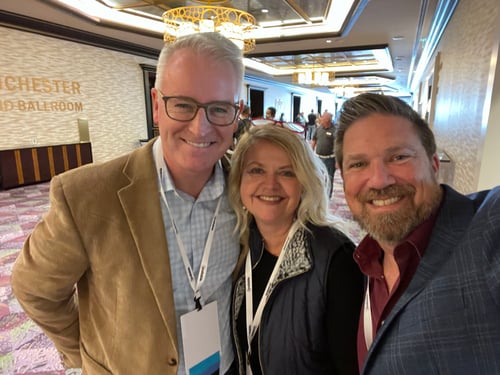
Four years later Kevin's in my top ten closest friends, one of maybe five I talk to regularly. Three times a week, in short bursts. He's one of my few friends that was actually born with as many words as I have. He's one of several people like that in my life, and every one of them got there on purpose.
None of this is new. Business groups have been around as long as business has. In 1905 four men in Chicago got tired of being alone. A lawyer, a tailor, a merchant, and a mining engineer wanted to be around people who would actually know them, and they decided they'd serve their community together while they were at it. Over 120 years later, that's Rotary International. 1.2 million members, 36,000 clubs, 200 countries, still gathering every week to share a meal. Lonely business owners built that on purpose.
Owning a company will isolate you if you let it. The hours don't leave much margin. And most of your relatives, your friends, even the people you sit next to at church can't relate to your leadership in the business world.
Kathryn and I understood the value of community early. Pastoring in the first years of our marriage taught us how to care for people and help them feel seen and valued. It also taught us how much we needed that ourselves. So we built it, on purpose, over years. Those people live all over the world, and here in the college town in Northern California we call home.
This past week I sat down with three different leaders. Only one of them is a client. The other two are friends, one old and one new, and each one carries a business or an organization on their shoulders. Every one of them told me some version of the same thing. They don't have many people like this to talk to. People who understand business and faith and actually care.
It's rarer than it should be.
An Invitation, and a Nudge
So I want to do two things. Invite some of you, and encourage the rest.
If you're anywhere near Chico on Thursday, October 1st, Kathryn and I are opening our home to start a new kind of gathering. A quarterly evening for Christian business owners and leaders. For-profit, nonprofit, or government, it doesn't matter. If you're responsible for other people, you're invited, 5:30 to 7:30 pm. Beverages, hearty appetizers, some encouragement from Scripture, and a room full of people who get it. If you're interested, just reply to this email.
If Chico's too far, here's the encouragement. Find one or two other leaders in your own community. Reach out. Get lunch once a month. You don't need a program or a big gesture. You need one person who understands what you're dealing with and won't try to fix it in a sentence.
And if none of this exists in your life yet, we'd love to help. Click here to set up a conversation, and let's talk about how to scale your leadership, your company, and the community around you.
You weren't created to lead alone. Nobody was. Not the founders sitting across from me each week. Not the men in that hospital room. Not you.
It's only lonely at the top if you stay up there by yourself.
Until next time,
Keep learning.
Keep growing.
And God bless,
Michael Redman
Half a Bubble Out (HaBO)
Business Consulting | Leadership Coaching


