

ISSUE #034 | THE LEADERSHIP CONTRARIAN
You've seen this interview.
Some founder who built something remarkable is sitting in a nice chair under good lighting, and the host asks the question they always ask: What taught you the most?
She pauses. Smiles a little. "Honestly? My biggest mistakes."
Everybody nods. It's humble. It sounds exactly like the truth. And a few million people walk away with the same conclusion: mistakes are the real teacher. Go make some.
I've spent twenty-four years working with founders and leaders of small and mid-sized companies. I've heard this kind of advice repeated over and over like it's sage wisdom that the Silicon Valley mystics discovered, and it's wrong - and it's got me a little hot under the collar.
Last week I saw it again, this time as a cute little cartoon on LinkedIn. That's what finally pushed me over the edge.
So if you'll excuse me for a moment, I'd like to pull out my soapbox and tell you why.
Two things before I get rolling
The guy who posted it seems like a genuinely nice person. He's not the villain here. I'm not gonna name him. I'd even buy him lunch.
And yes, you learn from your mistakes. Obviously. I've got a few that still make me wince.
So this isn't a fight about whether mistakes teach you anything. It's about a partial truth; and a partial truth is like an evil magic trick meant to deceive you while masquerading as some innocent entertainment.
This one uses a cute cartoon cat.
Description of the offending meme
I'm not going to show the meme to protect myself from potential copyright infringement. So envision with me.
The header across the top says: HOW MUCH YOU LEARN. Underneath that, there are three stacks of books: one on the left, one in the middle, and one on the right.
The first is titled Theory. It has four books stacked on top of each other, and they're colored red.
The stack in the middle is titled "Practice," has five books, and they're yellow.
The column on the right is titled "Mistakes.” It has twelve dark green books, towering over the other two like a California redwood. Leaning against it, a little wooden ladder. Climbing the ladder, a cartoon cat.

That cat looks playful and innocent and is putting the final green book on top of the stack. His whole job is to be adorable enough that you never question the claim underneath him.
Because while you're admiring the cat, look at what happened to the colors. They gave us a complete traffic light. Theory - everything human beings have already figured out about your business before you showed up - is red. Stop. Practice is yellow - proceed with caution. And mistakes are green - hit the gas.
This is the get-rich-quick idea that speaks to everyone's desire to find the shortcut that allows them to avoid the hard work.
Who's going to argue with a cute little cat that looks like he walked straight out of the old Tom and Jerry cartoons?
Now look closer at those stacks of books
Theory is something you go get. Practice is something you go get. Mistakes? Nobody goes and gets mistakes. There's no shelf for them at Barnes & Noble. You don't schedule them for Thursday at ten. They fall out of the practice while you're doing it.
So mistakes aren't a third way to learn; they're a side effect of practice. The meme took that side effect, stood it up like its own method, and drew it as the tallest stack of all three.
Nobody in history has piled up twelve books of mistakes without first doing the practice that produced them. The Mistakes stack is taking credit for the Practice stack's work.
There's a second move, easier to miss. Yes, the founder who has 25 years in business has made more mistakes than you. She's also taken a hundred times more shots, and her error rate today is a fraction of what it was in year two. That's the whole definition of getting good at something. But the meme counts her mistakes and decides that making them is what made her.
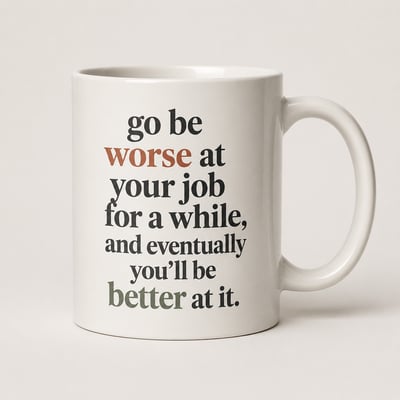
So the meme's advice, said out loud, is this: go be worse at your job for a while, and eventually you'll be better at it.
Print that on a mug.
But do we really learn the most from our mistakes?
Turns out that after fifteen years of this line getting repeated at every conference on earth, two researchers actually ran the experiment - five studies, 1,674 people, under a title I wish I'd written: "Not Learning From Failure - the Greatest Failure of All."
They presented the people in the study with a list of simple questions. Each question had two possible answers. You pick the answer you think is right, and they tell you whether it's right or wrong right on the spot. Either way, you now know the correct answer. Then they test you later to see if you can remember the right answers.
The people who'd been told they were wrong learned less.
Why? Failure stings. Your ego goes looking for cover, and the lesson never gets filed.
But here's the part that got me. When people watched somebody else fail, the effect disappeared. They learned just as much from another person's failure as from their success. It turns out your brain doesn't want to remember your own failure. So it doesn't. Somebody else's failure? No problem. The difference is whose ego is in the room.
Now. What exactly do you think a book on the fundamentals of your industry is?
It's a pile of other people's mistakes. Sorted, tested, argued over for thirty years, edited down by someone who cared enough to take out the parts that didn't hold up, and handed to you for twenty-two dollars. Every chapter is somebody saying please don't do what I did, it cost me more than you can imagine. (One caveat: pick who you read wisely.)
It's the only form of mistake human beings reliably absorb.
And that's the stack they painted red.
The green stack, the redwood, the one with the ladder? That's the pile your brain is specifically built not to read.
The trick worked. It got you to walk past the real stack to go climb the fake one.
End Rant…
Thanks for giving me that moment. :)
Here's the real point, and it's the part I actually care about.
Your mindset matters more than almost anything else you're managing right now. I want you to be successful. I want your team to thrive and to believe in where you're leading them.
When something like this meme floats by - pretty, cute, has a cat - you don't argue with it. You smile at it and scroll on.
But it doesn't leave. That cat climbs down off the page and moves into your subconscious if you don't stop it. And every so often, at a moment that matters, out comes its paw to trip you up. That sweet little smile turns into a grin. Got ya.
That's what I'm mad at. Not the guy. The message behind the cartoon.
Now let me argue against myself
I’ve said that mistakes aren’t the best way to learn. But if that makes you slow down and play it safe, I’ve failed you. Because the opposite mistake is just as expensive.
I know both kinds of leader, and I've watched both of them lose.
One decides like this: shoot, shoot, shoot, aim. He's proud of it. He'll tell you speed is his edge. What he doesn't count is how much of his year goes to unwinding last quarter's decision.
The other one wants to be wise. So he studies it, and studies it, and eighteen months later the window's closed and he never wrote a check. He calls that wisdom. His team calls it something else.
Neither one is exercising good judgment. They each picked a default and dressed it up in a virtue. There's a leadership competency called decisiveness - making decisions on time, with the information actually available - and both of them are failing it from opposite ends.
Fear of making mistakes has a cost, but so does recklessness. Good judgment is about making the best decision you can, with what you know, in the timeframe the decision requires.
A number worth checking
So here's the one thing I'd ask you to do. Think about last year. Where did your real learning come from?
If most of it came from mistakes, that's not a badge. That's a diagnostic. There are only two explanations: either you're making bad decisions at an unusual rate, or you're not learning from the decisions that turned out ok.
That second one is the one almost nobody checks. When things go wrong, we study every detail: something blows up and there's a meeting, a post-mortem, four people asking what went wrong. The deal that closed on time? The hire that worked out? We high-five and move on.
That's a positive experience, and it's giving you the best opportunities to learn from, the easiest kind for your brain to absorb. It's sitting untouched every single week. Nobody's ego gets bruised reviewing a win.
Now, don't get me wrong. You should absolutely learn from your mistakes. That matters.
But here's what I've seen in twenty-four years of working with leaders of small and medium-sized companies: most leaders aren't systematic about anything - not their mistakes, and not their wins. So yes, dig into the big mistakes and fix them.
Just don't stop there. The wins are where the easy learning is. Figure out what went well, build it into your systems, and repeat it over and over again.
Here’s what I would suggest
Study your fundamentals on purpose, on the calendar, like a meeting you can't move.
Get your reps. Make the decision on time, with what you've got, and don't apologize for it.
Review everything, not just the disasters. Ask what worked and why, while nothing is on fire and nobody's defending themselves.
And when you do make a mistake - you will - mine it hard. You already paid for it. Just don't go shopping for more.
The founder in that interview never meant to go out and make mistakes on purpose. She meant don't be paralyzed by them.
But somewhere along the way we built a twelve-book stack, painted it green, leaned a ladder against it, and sent a cute little cat climbing to the top.
Mistakes belong in the picture. Of course they do. They just don’t deserve to tower over theory and practice.
Get off the ladder.
Until next time,
Keep learning.
Keep growing.
And God bless,
Michael Redman
Half a Bubble Out (HaBO)
Business Consulting | Leadership Coaching


