
ISSUE #026 | THE LEADERSHIP CONTRARIAN
Every serious business owner I've ever met says they care about culture.
Most of them have read the books. Listened to the speeches. Sat through the conference talks. They know it matters.
And yet, culture remains one of the biggest reasons people leave companies. One of the biggest drivers of inefficiency. One of the biggest sources of stress for the leaders carrying the weight.
So why does the problem persist?
Because most of us treat culture the way the ancients treated weather.
They didn't have the science to predict it. They saw the sky change, felt the wind shift, watched the storm come, and they did the best they could. When they ran out of explanation, they appealed to the favor of the gods.

We do something similar with culture.
We talk about it. We try to address it. We hope for the best when it goes sideways. But underneath, most leaders don't actually know what's happening or what's coming next.
Here's the thing: we know far more about culture today than the ancients ever knew about weather.
It can be measured. It can be predicted. The slide from healthy to broken follows a pattern that has been studied for over fifty years.
Let me show you what that pattern looks like.
The Contrarian Truth
Most leaders think culture is soft, hard to measure, and hard to wrap your arms around.
So when they finally see a problem, they look for the familiar markers - disengaged employees, quiet quitting, turnover spikes, a department that's lost its edge.
Here's what I want you to see:
Those aren't phase one of a culture slide. They're phase three, phase five, and phase six.
By the time you see them, the slide has already been compounding underneath for months, sometimes years.
This is why so many owners feel blindsided when a "good" team suddenly fractures.
You weren't blindsided. You were watching the wrong gauge.
Why This Matters
For 25 years, Kathryn and I have built companies that treated culture as a core piece of the operating system, not the decoration. We've also coached leaders whose companies were profitable on paper while quietly bleeding people, energy, and trust at the same time.
Yes, a company can be worth $100M with a broken culture. Most of us have worked at one or known someone who did.
But for most owners running businesses in the $2M to $20M range, culture and profitability move together. And the cost of a bad culture is far higher than most owners ever calculate.
MIT Sloan's research on the Great Resignation found that toxic culture was roughly 10 times more predictive of someone leaving than compensation was.
Translation: most people don't quit over pay. They quit over culture.
The 6 Phases of a Declining Culture
Here’s the pattern, drawn from over 50 years of data through Dr. Steve Byrum's work at the Judgment Index, and matched against what Kathryn and I have watched play out in real companies.
The Judgment Index is a values-based assessment grounded in the work of Dr. Robert S. Hartman, who was nominated for a Nobel Peace Prize in the 1970s for his research on measuring human judgment.
The Index has since been used across the U.S. Air Force, the U.S. Army, major healthcare systems, Yale School of Business, and companies of every size and industry. What it measures is how leaders form judgment.
That matters here because most problems in companies, large or small, come down to poor judgment, or to not having the information needed to have good judgment.
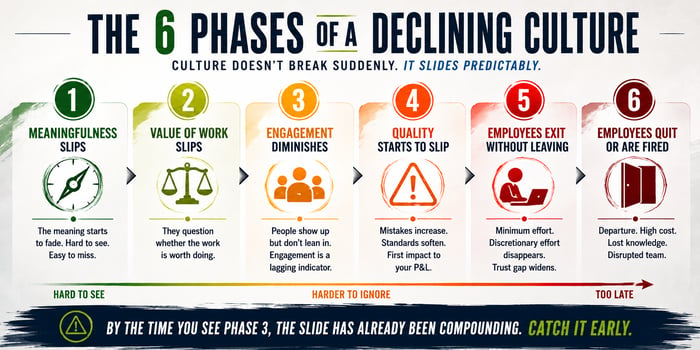
Phase 1: Meaningfulness slips
Employees still see the value of the work. They still believe in what the company does. But the meaning starts to fade.
You won't see this in engagement scores or productivity. You'll only see it if you're measuring values directly.
This is the quietest phase, and the most important one to catch.
Phase 2: Value of work slips
Now they're not just feeling less meaning. They're starting to question whether the work itself is worth doing.
People begin to detach internally. Outwardly, everything still looks fine.
Phase 3: Engagement diminishes
This is where most leaders finally notice. People show up but don't lean in. Meetings flatten. Ideas dry up.
Here's the point most owners miss: engagement is a lagging indicator.
By the time your engagement scores move, you've already been in decline for two full phases. The horse has left the barn and you're watching it walk down the road.
Phase 4: Quality starts to slip
Mistakes increase. Standards soften. Errors that used to get caught are now slipping through.
This is the first phase that hits your P&L directly, but it's also where leaders most often misdiagnose the problem. They tighten processes when the real issue is starting much earlier and they just don't know to spot it.
Phase 5: Employees exit without leaving
The world has been calling this quiet quitting for the last few years.
People give you the minimum. Eight hours of presence, three hours of work. Sick days climb. Discretionary effort - the extra time, energy, and enthusiasm employees choose to give beyond their basic job - disappears.
Data from “Great Place to Work” shows that high-trust cultures generate 42% more discretionary effort than low-trust ones. Phase 5 is where you watch that gap evaporate in real time.
Phase 6: Employees quit or are fired
The slide ends with departure.
The Society for Human Resource Management (SHRM) puts the total cost of replacing a single employee at 90% to 200% of their annual salary... once you count recruiting, onboarding, ramp time, lost institutional knowledge, and customer disruption.
On a $65,000 hire, that's a $58,000 to $130,000 hit. For one person.
A quick note on phases 1 and 2: they are measurable. Kathryn and I use the Judgment Index with our coaching clients because it surfaces the values shift before engagement scores ever move, which is the whole point.
What This Is Actually Costing You
Here is where culture stops being soft.
Gallup's most recent meta-analysis covers 183,806 business units and over 3.3 million employees, one of the largest workplace datasets ever assembled. Teams with the strongest cultures consistently show:
- 23% higher profitability
- 18% higher productivity
- 81% lower absenteeism
- 32% to 41% fewer defects
- 18% to 51% lower turnover
Those aren't soft numbers. Those are operating numbers.
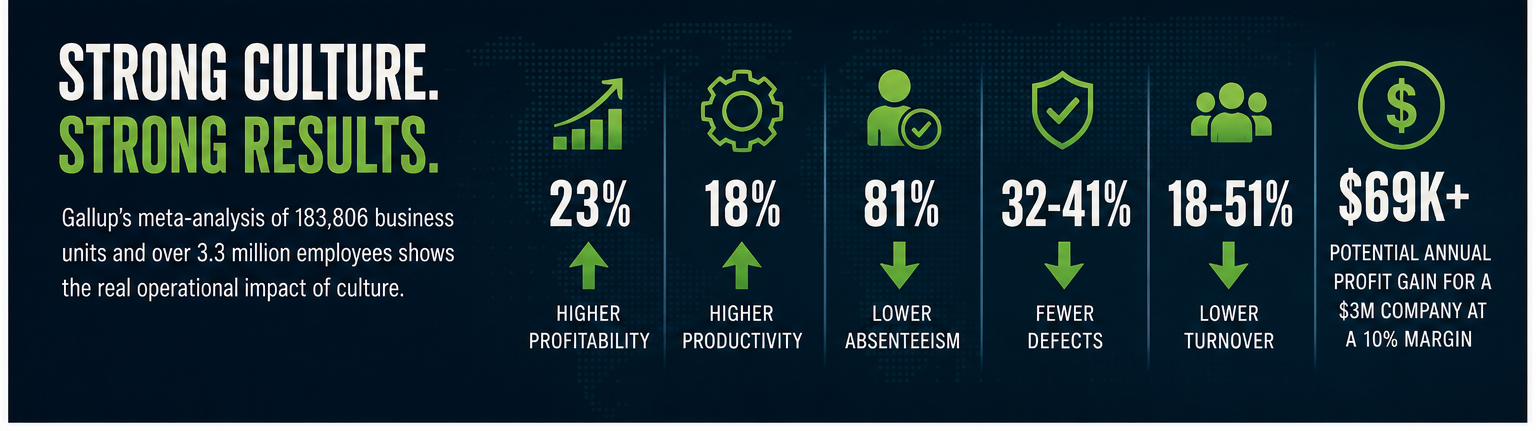
For a $3M company at a 10% margin, the profitability gap alone is roughly $69,000 a year. That gap just gets larger when you count the savings in recruiting or the quality that was lost or even before you count the negative impact to customer retention.
What it boils down to is this: the culture that so often feels intangible to the owner is showing up as five- and six-figure swings on the bottom line.
The Real Shift
Most owners try to fix culture from phase 3 onward after engagement softens, turnover spikes, and a key employee walks.
By then, you're not building. You're rebuilding.
The leaders who win the culture game are the ones who learn to see phase 1 and phase 2. The slow loss of meaning. The quiet erosion of value. The small disengagements that haven't yet shown up anywhere except in the right assessments.
Culture doesn't break suddenly. It slides predictably.
The slide is catchable, but only if you know what to watch for.
In Closing
Most leaders don't lose their culture because they didn't care. They lose it because they were watching the wrong gauges.
Phase 3 was when their dashboard light, called engagement, came on. Phase 1 was where the leak began.
If you're seeing the dashboard light right now - engagement softening, quality slipping, key people getting quiet - the answer isn’t to crack down on everyone and push harder. It's to find the leak where it started.
What do your people still find meaningful? What do they still believe is worth doing?
Those two questions are Phase 1 questions. And they will tell you more about the real state of your culture than any engagement survey ever will.
One more important note before we close.
According to our friends at Gallup, managers explain roughly 70% of the gap in team engagement, making them the single biggest factor in whether a team remains healthy, productive, and aligned, or begins moving through the 6 phases we just explored.
But in companies between $2M and $20M, the senior leader usually is the manager, or sits one degree from every manager in the building.
Which means the manager problem is almost always a senior-leader problem too.
That's a conversation for another issue.
If this was helpful to you, email me and let me know.
Until next time,
Keep learning.
Keep growing.
And God bless,
Michael


