
ISSUE #037 | THE LEADERSHIP CONTRARIAN
Food can teach us a lot about life and leadership.
I love good meatloaf, but that wasn’t always the case.
Meatloaf has received some bad press over the years. Some people love it. A lot of people hate it, as if they'd been subjected to some form of childhood meatloaf trauma.
My mom was a great cook, but her meatloaf was tolerable at best, and thank goodness she rarely made it. I grew up in the '70s and early '80s, and most of my friends' moms made the same tolerable meatloaf. If I heard, "Meatloaf is for dinner," I'd groan and drop my shoulders like I was being tortured.
Then, for my 14th birthday, we spent a weekend with family friends, David and Martha, in San Anselmo, California. If you’ve never been there, it’s beautiful, and for me it was magical. That weekend, Martha made her special family meatloaf recipe for my birthday, and it was amazing.
It opened my eyes and my taste buds to what meatloaf could taste like. Full of flavor, perfectly cooked hamburger, and a few other secret ingredients. That was nearly fifty years ago, and I still remember it fondly.
Over the years, I've ordered wonderful meatloaf from London to Los Angeles and most places in between. It’s one of those things Kathryn and I occasionally crave, and as a person who loves to cook and entertain people, I love to test others’ recipes.
In fact, just last week Kathryn and I were in Austin for business and found ourselves eating meatloaf cupcakes. They had mashed potatoes swirled on top like icing, with little pieces of carrot and peas scattered on like sprinkles.
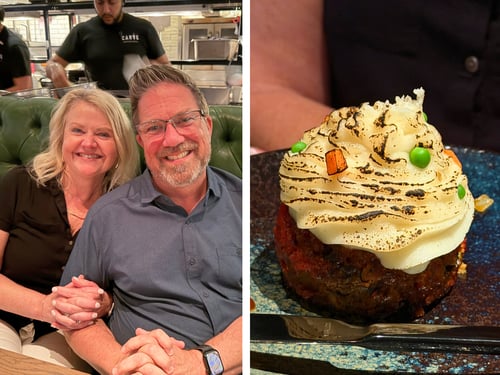
I am serious about this. It was amazing.
And here's what meatloaf has taught me, which turned out not to be about food at all.
Bad meatloaf is almost never made by lazy people. It's made by someone who drove to the store, spent the money, stood in the kitchen, and worked every bit as hard as Martha did to feed their family. Similar effort. Same hour in the kitchen. Completely different result.
The same is true for leadership.
Two leaders can invest the same time, money, and resources to lead their company and come out the other end with two vastly different results. One produces mediocre results, like most meatloaf. The other produces amazing results, like the rare few.
Mediocre leadership works. That’s what makes it so hard to see.
Stay with me on this, because cooking has more to teach us about leadership than you might imagine. (I thought about using whiskey as an example too, but I’ll save that for another issue.)
Three Conditions
Every dish you make has three conditions that decide whether it's worth eating, and meatloaf is no different.
The ingredients. You have to have the right ones.
The assembly. How you combine them, and in what proportion.
The method and the timing. Bake, barbecue, smoke, pan-fry. And one of my favorites, sous vide.
Miss any one of the three, and the other two can't save you.
Meatloaf makes this obvious, but for those of you who haven’t studied meatloaf, let me explain. It needs fat - enough fat. Here's where most people go wrong: they try to avoid a greasy result, so they buy meat that's too lean. But lean doesn't fix the grease problem. Lean meat just dries out in a meatloaf. The fix for grease was never in the meat you bought; it was in how you prepared it.
It also needs quality. As it turns out, quality ingredients bring far more flavor to any dish. When the food is fresh, we can taste the difference. In a world of convenience and price shopping, we find tons of products with little flavor in the grocery store. Quality ingredients let you experience far more flavor.
And it needs a panade, which is a fancy cooking term for a mixture of starch and fluid. Its entire job is to help stop the meatloaf from drying out. Most great recipes use bread or breadcrumbs soaked in milk, mixed in before the meat ever sees the pan. It's the thing almost nobody's mother did. It's what holds the moisture in while everything else is trying to drive it out. I was taught to use breadcrumbs, but never the milk or water.
Now watch what happens with those three.
Too lean with no panade, and it dries out. A panade with no fat, and it's moist but it tastes like nothing. Get both right and then work the meat too hard, pack it too tight, and you've made a dense rubber brick, which flushes every dollar down the drain. And if you did buy quality ingredients, it’s even more money swirling away.
You can't fix a missing ingredient by just working harder.
Then there's the oven. The right pan, the right temperature, long enough for the inside to come out tender while the outside builds that crust, which we call the Maillard reaction, where the texture and the natural savory flavors come together.
My mouth is watering just writing this.
So what are the ingredients of great leadership?
The Six Ingredients
Leadership that scales, the kind that lets a company scale, has six conditions. Six ingredients.
They are:
- Creative Leadership
- Deep Relationship
- Radically Human
- Systems Awareness
- Purposeful Achievement
- Generative Tension
Here's the part most leaders skip. Just having them isn't the same as having them at the right quality and the right proportion.
Take Deep Relationship. You cannot simply have relationships with the people you lead and assume everything is good. That's the low-fat mistake - technically present, functionally useless. Deep Relationship means you actually know how to build trust, deepen it, repair it when it breaks, and earn people's willingness to go with you toward something hard. Relationship with depth. There's a real difference between people who like you and people who will follow you into a difficult year in pursuit of a worthy purpose.
That's true of all six. None of them is a single thing you either have or don't have. Each one breaks down further into real, specific competencies that can be measured and developed. Which is why "I'm good with people" is not a good enough answer.
It’s like saying, “I know how to buy hamburger,” while your meatloaf still tastes mediocre.
There’s more to it.
Creative Leadership is a mindset. It's playing to win instead of playing not to lose. It’s a combination of skills and mindsets that allow you to see business and leadership in a very different way than roughly 80% of the leaders out there, according to Leadership Circle data. It’s more about love than fear, and it’s more about going somewhere new instead of just trying not to lose anything.
Radically Human is knowing you're not perfect, you need other people, and you still have things to learn. Or, as Patrick Lencioni puts it, humble, hungry, and smart. Hungry enough to keep growing. Humble enough to know you won't always be right. Smart enough to understand people and work well with them. And knowing how to be appropriately vulnerable.
Systems Awareness is seeing how things fit together. Early on, a business is necessarily haphazard; everyone's doing the best they can without enough resources. But what got you here won't get you there. Eventually, you need predictable systems and more structure without going overboard. Great leaders understand that design determines performance.
As you grow your own leadership, you learn you need to build the organization's leadership capacity too. Systems allow your entire team to understand where they need to be and when, without you having to be there to tell them. It allows your people to work independently and make better decisions.
Which is every entrepreneur's dream, right up until they realize it requires them to change.
Purposeful Achievement is getting the right things done when they need to get done. As leaders grow, the most common place they become the bottleneck is decision-making. Learning to decide well and keep the organization moving takes more nuance and more time than anyone expects.
Generative Tension is living in the messy middle between where you are and where you're going. You don't abandon the vision because it's taking too long. And you don't get so impatient that you rush your people into bad decisions or turn into the guy cracking the whip because nobody's moving fast enough.
The Ingredients Aren't the Dish
But remember, ingredients were only the first condition. How you put them together matters too.
A list of ingredients on the counter is not a meatloaf.
What makes a dish is that the ingredients change each other. Fat carries seasoning into everything it touches. The panade holds the moisture the fat would otherwise lose. The egg binds it so it holds a slice. Pull one out and the others don't just go missing, they get worse.
The six ingredients or conditions to Scale Leadership work the same way. Each one makes the other five stronger.
You can't have Deep Relationship while skipping Radically Human, because being radically human is how relationships get depth. Purposeful Achievement without Systems Awareness turns you into the bottleneck. Generative Tension without Creative Leadership isn't tension at all. It's just anxiety.
Six ingredients, each one making the other five better. That isn’t addition. It’s exponential.
And that is the whole answer to why great leadership eventually costs less energy than mediocre leadership, not more. Mediocre leadership is additive. You push each thing by hand and you get exactly what you pushed. Great leadership compounds. The same effort keeps paying you back through five other doors.
Then there's timing, and there's no way around it. If you're in a hurry and you think, if it works at 350 it'll work at 500 and I'll be done sooner, it doesn't work that way. Cooking rewards the right temperature for the right amount of time. So does a leader. It's a fair investment, and it is not an insignificant one.
The Ceiling You Can’t See
Here’s the part that’s hard to see from inside a company.
Mediocre leadership can build a perfectly respectable company. That’s what makes it so hard to recognize. Because it works, the leader may never realize how much harder everything is than it needs to be, or what might actually be possible with better leadership.
You can be profitable, grow, create jobs, and look successful by almost every normal business metric while still being unaware that there’s another level available to you.
And eventually, almost every leader hits a ceiling.
The way you’ve been leading, the same way that helped you build the company and get this far, stops working as well as it used to. You work harder. You push more. You make more decisions. You carry more of the load. But somehow, the company doesn’t move forward the way it once did.
You haven’t necessarily reached the limit of what you’re capable of. You may have reached the limit of what your current way of leading can produce.
It’s a lot like the meatloaf. The cook isn’t incapable of making better meatloaf. Their current recipe and technique have simply taken them as far as they can.
That’s an important difference.
Because if you think you’ve simply reached your limit, or that the company has reached its limit, you may settle. But if you realize the ceiling is in your current way of leading, then that can change.
The difficult part is that you often can’t see what’s beyond that ceiling while you’re still underneath it. Until you experience better leadership up close - or somebody helps you see what’s possible - the next level can remain invisible.
If you can’t see a better way, it’s hard to imagine one, much less start moving toward it.
People can’t find their way until they see a way.
I know that because I’ve had the privilege of seeing that better way up close.
What People Remember
I've been blessed to work under a few genuinely great leaders, and it left a mark on me I still carry. It made me a better person. It left me with skills I didn't have. It left me better off.
The same difference shows up in the companies those leaders build.
I'm not talking about the difference between bad business and good business. I'm talking about the difference between mediocre and great.
The difference between “They gave me what I needed. It was fine.”
And “Those people did such a great job. I'm telling everyone, and I'm going back.”
One of those is a transaction. The other becomes part of what people remember.
Just last night, Kathryn and I watched a film called The Brink of War, about Reagan and Gorbachev in 1986 trying to deal with the fact that, between them, they had the power to end nearly everyone on earth. A line came back more than once: Good leaders make things better now; great leaders make things better for the future.
I believe every leader reading this has the ability to be a great one - in your company, for your family, your friends, your community, and your employees.
Don't just become the leader who makes today work.
Become the one who makes tomorrow better.
If you read this and thought, I want that, but I'm not sure how to get there, that's the work Kathryn and I have been doing with leaders for more than two decades.
No pitch. Just a conversation about where you are and where you want to go.
Reach out. It'd be an honor.
Until next time,
Keep learning.
Keep growing.
And God bless,
Michael Redman
Half a Bubble Out (HaBO)
Business Consulting | Leadership Coaching


