

ISSUE #011| THE LEADERSHIP CONTRARIAN
I believe thriving should be normal in business.
But there’s a problem.
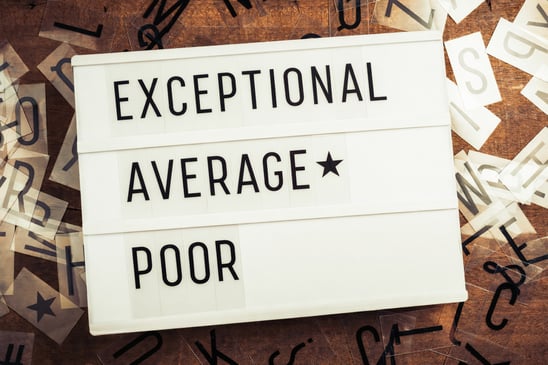
We’ve normalized “average”.
And in the process, we’ve watered down the very idea of thriving.
For decades, most of our systems - education, management, leadership development - have aimed at a simple goal: move people up to average.
If someone struggles, we help them reach the middle of the bell curve.
And if someone rises far above it, we treat them as the exception. Something unusual. Something rare.
"Good for you," we say. "You’re one of the special ones."
But average was never meant to be the goal.
Average is simply the midpoint of what exists today - not the ceiling of what’s possible.
A few decades ago psychologists began studying something they called flourishing. Instead of asking how to move people from struggling to average, they asked a different question:
What’s happening in the lives of people who are truly thriving?
What they discovered was important.
The outliers weren’t just lucky.
They were revealing what was possible.
And I believe the same thing is true in business.
When you see a company that is genuinely thriving - not just profitable, not just getting by, but flourishing - it tells you something.
Thriving isn’t a fantasy.
It’s a possibility.

Look closely at organizations that are truly thriving and a pattern appears.
Thriving doesn’t happen in one place.
It moves through a system.
The leader thrives.
The people thrive.
The company thrives.
And customers benefit from it.
When those pieces align, something powerful happens: thriving reinforces itself.
It becomes a cycle - like a champagne tower where the top glass fills first and spills into the others.
Energy, health, and momentum move through the system.
And just like a champagne tower, if the top glass is empty, all the other glasses will be empty too.
And one of the clearest ways to see this principle isn’t in theory.
It’s inside great organizations.
At Half a Bubble Out we’ve tried to design our company around this idea from the beginning. The goal was never just to build a profitable business. The goal was to build an environment where flourishing cascades through the system—where the leader grows, the team grows, the company grows, and that health spills into how we serve clients.
We’re not perfect. No company is.
But the idea has shaped how we build the company, make decisions, and develop people.
Once you start looking for this pattern, you begin to see it everywhere.
Author Dr. Benjamin Hardy talks about something similar when he challenges the way we think about growth. Most businesses assume growth is linear - incremental and slow.
But Hardy argues that scaling - true multiplication - is possible. His work helps leaders normalize scaling instead of assuming extraordinary growth is reserved for rare outliers.
In the same way, thriving organizations shouldn't be rare.
Thriving should be normal.
And beneath both ideas sits a deeper truth: multiplication appears to be built into the fabric of the world. For those of us who view business through a spiritual lens, it’s hard not to notice that God seems particularly fond of multiplication. When leadership is rooted there, you may discover more resources than you thought possible.
But thriving inside a company doesn’t begin everywhere at once.
Like the champagne tower, it starts at the top.
If you want a thriving organization, the first place to look isn’t strategy, the org chart, or even culture.
It’s the leader.

The Leader Thrives First
Thriving organizations begin with leaders who are growing, grounded, and fully engaged in work that feels like a calling.
Years ago I encountered an exercise Stephen Covey described in The Seven Habits of Highly Effective People: begin with the end in mind. Imagine your funeral. What do you hope people say about the life you lived?
That question shaped my thinking long before I started Half a Bubble Out.
I didn’t just want to build a successful company. I wanted a life worth living.
A strong marriage.
Real relationships with my kids.
Lifelong friends.
A faith that was lived, not sidelined.
But I also had to wrestle with something else: work.
Growing up, work didn’t look inspiring. My dad was successful in many ways, but work often made him miserable. He told me fulfillment in work wasn’t really possible; that work was simply something you endured to pay the bills.
For years, I believed him.
Eventually I began to question it. I started noticing something surprising: when work aligns with how you’re wired and the value you bring to others, it can actually give life instead of draining it.
That realization changed how I thought about leadership.
If I wanted a thriving life, my work had to support it—not compete with it.
And because I’m wired entrepreneurially, that eventually led me to build a company.
But before designing the company, I tried to picture the life I hoped to look back on someday.
Then I asked a harder question:
What kind of business would allow that life to exist?
That question shaped Half a Bubble Out.
The work would be hard. Success would take time. But the company couldn’t violate the most important parts of life.
The business had to make room for faith.
It had to protect my marriage.
It had to allow me to be present as a father.
Because thriving leaders don’t sacrifice their lives to build companies.
They build companies that support the lives they were meant to live - and the contributions they were meant to leave.
That’s the invitation for every leader reading this.
Don’t start a company simply chasing wealth, assuming money will eventually make you happy.
Start one because building something fits your gifts, talents, and skills - and because it allows you to create real value in the world.
Design a company that supports your faith, your family, and the life you’re trying to build.
Serve people well. Solve real problems. Create real value.
The money usually follows.
That path is far healthier than building a business that slowly drains the life out of you.

The Employees Thrive
When leaders build companies this way, something important happens inside the organization.
A leader who finds purpose and satisfaction in their work begins to recognize that every human being is looking for the same things.
People want dignity in their work.
They want to contribute.
They want to use their gifts.
And they want to earn a living that allows them to care for the people they love.
So thriving leaders don’t simply fill seats. They design roles well and hire people whose gifts actually fit those roles.
In thriving companies we try to create what we call passion and provision jobs.
Jobs where the work matters.
The person fits the work.
And the paycheck supports a real life for the people they love.
That doesn’t mean every day is exciting. But it means the work has dignity and the person can take pride in it.
Not every job will be high‑paying. But every job should allow someone to build a stable and dignified life.
When leaders take this responsibility seriously, employees don’t just work for the company - they flourish inside it.
And when employees thrive, you can see it.
They take ownership.
They improve things without being asked.
They collaborate well.
They bring energy instead of draining it.
You see pride in their work, creativity in their thinking, and resilience when things get hard.
Thriving employees strengthen teams, improve culture, reduce unnecessary conflict, and help new people succeed faster.
Training great people takes time. But the payoff is enormous. Thriving employees develop judgment and independence. They solve problems, make decisions, and act in alignment with the company’s purpose and values.
In other words, the entire environment of the company begins to change.
Energy rises.
Ownership increases.
Problems get solved faster because people think instead of simply complying.
People stop showing up only for a paycheck.
They show up because the work matters—and they know they matter.

The Company Thrives
When leaders thrive and employees thrive, something larger begins to happen.
The company itself begins to thrive.
Not just financially - though that often follows - but operationally and culturally long before the numbers appear.
Communication improves.
Problems get solved faster.
Innovation appears naturally because people feel safe sharing ideas and taking ownership.
Teams become more resilient because they trust each other and understand the purpose of the work.
Customers feel the difference.
Research supports this pattern. Large studies tracking hundreds of thousands of employees show that companies with highly engaged teams consistently outperform others.
You see it in the basic operating numbers.
Retention improves. When great employees stay longer, the time and capital invested in them compounds instead of disappearing every few years. Replacing an employee can cost one to two times the salary of the role. A $60,000 position may require $60,000–$120,000 in recruiting costs, training time, and lost productivity before the replacement is fully effective.
Engagement also increases productivity. When people care about their work, the value produced per employee rises. Revenue per employee improves. Profit per employee improves.
And engaged employees strengthen the whole system. They train others, support teammates, and reduce management friction.
Over time those effects compound.
Stronger retention.
Stronger productivity.
Healthier teams.
Eventually those improvements show up in the financial results. Some research suggests companies with highly engaged employees become roughly three times more profitable than those at the bottom.
But the financial results are only part of the story.
Teams like this also create the conditions for multiplication.
When leaders thrive, employees thrive, and the culture supports initiative and judgment, organizations become capable of far more than incremental growth.
These are the kinds of teams that can launch exponential growth.
In the right conditions, that can mean 10× growth in just a few years - not because of one breakthrough idea, but because a healthy, aligned team executes and adapts together.
Eventually the company stops running primarily on pressure and begins running on alignment.
Alignment between the leader.
The people.
The purpose of the work.
And the value delivered to customers.
Companies like that are difficult to replicate.
And when you see one, you realize something important.
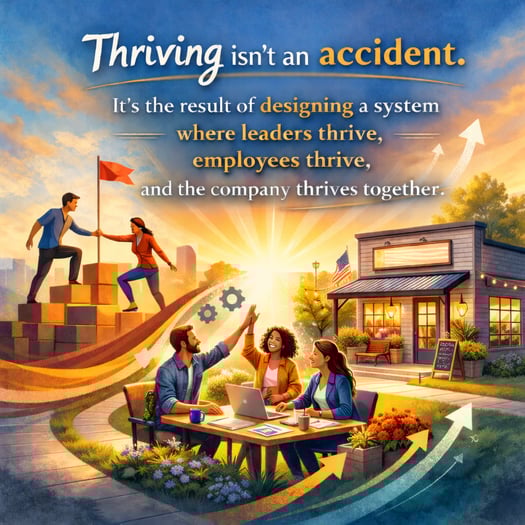
Thriving isn’t an accident.
It’s the result of designing a system where leaders thrive, employees thrive, and the company thrives together.
Which brings us back to the beginning.
Thriving should be normal in business.
But for too long we’ve normalized average.
We’ve built companies expecting just enough engagement, just enough effort, just enough performance to keep things moving.
The companies that truly stand out refuse to accept that standard.
They design leadership differently.
They design roles differently.
They think about people differently.
They build systems where leaders grow, employees contribute at their best, and the company becomes stronger because of it.
When you see a company like that, it may look rare.
But it doesn’t have to be.
Thriving was never meant to be rare.
Thriving becomes normal when leaders stop settling for average and start designing companies where people - and the business itself - can flourish.
Your Turn
If any part of this resonated with you,
even a sentence,
Would you send me an email and tell me?
I really value your feedback and it tells me if I’m making a difference or if I need to course correct.
Until next time,
Keep learning.
Keep growing.
And God bless,
- Michael


