

ISSUE #016| THE LEADERSHIP CONTRARIAN

I remember listening for my dad’s footsteps when he came home. Not because I knew I’d done something wrong… but because I didn’t know what version of him was walking through the door.
Some days were fine. Some days weren’t. And you could feel the difference before a word was ever spoken. Your body would tighten. Your guard would go up. You’d brace for what might happen next.
But that wasn’t my only experience growing up.
When I spent time with my grandparents, it was completely different
When my grandfather walked into the room, there was a sense of peace. He was steady. He was present. He enjoyed people. He created an environment where you could relax, where you could try, where you could fail - and it was okay.
You didn’t brace.
You settled.
And I didn’t realize it at the time, but I was experiencing two very different kinds of leadership.
I didn’t have language for it then. But I do now.
That wasn’t about discipline or personality.
It was about presence.
Leaders carry something into every room they walk into, and whether they realize it or not, everyone else feels it.
And in every leader I’ve ever worked with or observed, some version of one or the other is present.
The Real Issue Most Leaders Miss
Most leaders think they’re leading through pressure - the pressure of business, the market, the economy, the team, the decisions, the constant complexity of running a business and a life.
And those pressures are real.
But they’re not the real issue.
In reality, they’re leading from whatever is happening inside them.
Because what’s inside you doesn’t stay inside you.
It becomes the experience of everyone around you.
Because our inner game determines our outer game.
Leadership Is Not Neutral
Leadership is not neutral. It transmits.
People don’t just hear your words, they feel your state. They can feel tension, anxiety, defensiveness, urgency… or calm, clarity, and confidence. Children feel it in their parents. Spouses feel it in each other. Teams feel it in their leaders.
People sense peace - or the lack of it.
Over time, they respond accordingly. They lean in or they shut down. They engage or they withdraw. They trust… or they protect themselves.
What a Non-Anxious Presence Actually Is
For years, we’ve used a phrase to describe the kind of leadership that creates stability instead of tension: a non-anxious presence.
It’s not passivity. It’s not detachment. And it’s not pretending everything is fine.
A non-anxious presence is being fully aware of reality… without being controlled by it.
It’s the ability to stay grounded, clear, and steady, even when things are difficult. You’re aware of the pressure. You feel what’s real. But you’re not driven by it.
And that changes everything.
This Isn’t All or Nothing
It’s important to understand this clearly.
This isn’t an all-or-nothing concept.
Very few leaders are completely reactive all the time. And very few are perfectly calm and steady no matter what happens.
Most leaders live somewhere in the middle.
They’re doing pretty well. Things are stable. They’re leading with a reasonable level of clarity and confidence. And then something happens - a comment, a decision, a challenge they didn’t expect.
A button gets pushed.
And in that moment, they don’t act, they react.
Their emotions move first. Their thinking follows later. And before they’ve had a chance to regain clarity, they’ve already said something, decided something, or set a tone that shifts the entire room.
Most leadership breakdowns don’t come from constant dysfunction.
They come from moments of reactivity.
A Continuum Most Leaders Don’t See
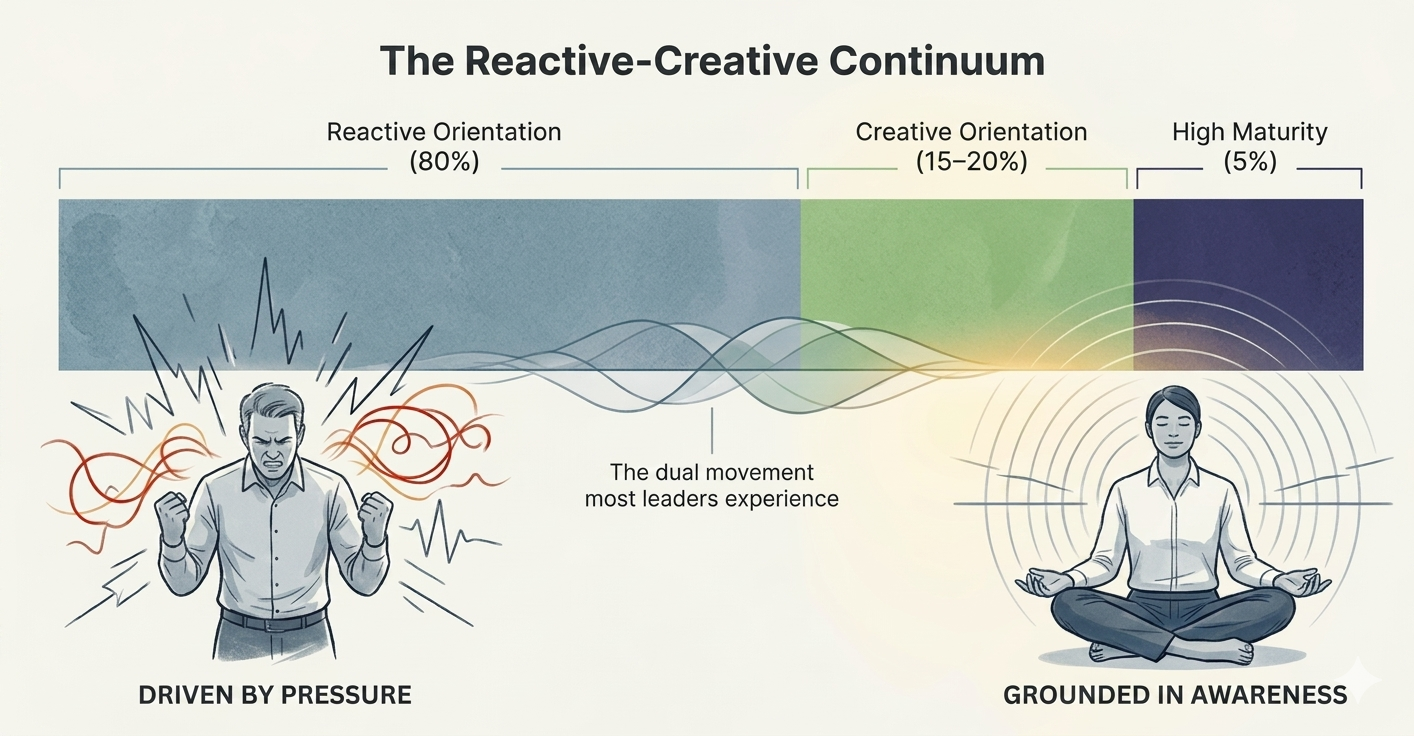
Reactive and creative leadership aren’t two boxes you fall into. They exist on a continuum.
Every leader moves along that spectrum - sometimes daily, sometimes moment to moment.
At one end, leadership is primarily reactive - driven by pressure, fear, control, or the need for approval. At the other end, leadership is primarily creative - grounded in clarity, purpose, and awareness.
But this continuum is not evenly distributed.
Research shows that roughly 80% of leaders operate primarily from a reactive orientation, meaning more often than not, they’re influenced by internal pressure. About 15–20% operate more from a creative orientation, where they’re grounded and intentional more often than reactive. And a very small percentage - around 5% - operate at a higher level of maturity, where reactivity is still something they’re aware of, but it never defines their leadership and rarely rises to the surface in a way that impacts others.
So when we say “most leaders are in between,” we don’t mean evenly spread.
We mean most leaders move along the spectrum, but within a relatively narrow range, not in wide swings. And for most, that range sits more on the reactive side of the spectrum than the creative side.
Where This Shows Up
Some leaders carry a low-level tension most of the time - slightly defensive, slightly on edge, carrying more pressure than they realize. It’s not extreme, but it’s consistent, and over time it becomes the emotional climate of the team.
Others are generally steady and grounded, but get thrown off when something hits a deeper trigger. When that happens, the shift is noticeable. The volatility shows up quickly, and the environment changes with it.
Both patterns matter.
Because in both cases, what’s happening internally is shaping what everyone else experiences externally.
What Actually Changes
The goal isn’t perfection.
The goal is to extend your baseline of peace and strength - longer, steadier stretches that hold under pressure.
Less time being driven by your emotions. More time leading with awareness, clarity, and intention. Less volatility. More stability.
And as that shift happens, your leadership changes.
Your thinking gets clearer. Your decisions improve. Your communication strengthens. Trust builds faster. Conflict becomes more productive. Your team feels safer - and people do their best work in environments where they feel safe.
You also attract different people.
Grounded leaders attract grounded people. Clear leaders attract capable people. Stable leaders build stable organizations.
Why This Matters More Than You Think
This isn’t just about personal growth. It’s about performance.
When a leader operates from internal pressure - even subtly - it impacts everything: decision-making, relationships, execution, and culture. Over time, that pressure spreads.
Emotions are contagious. Negative states spread quickly, but so do calm, confidence, and clarity.
When a leader develops a non-anxious presence, they don’t spread pressure.
They create stability.
And that stability becomes the foundation for everything else to work.
How This Actually Develops
This doesn’t happen by trying harder in the moment.
It happens by doing the work outside the moment.
A non-anxious presence is not a technique. It’s a developed capacity.
It starts with self-awareness by understanding your reactions, triggers, and patterns. It requires a commitment to growth and a decision that you’re not going to stay where you are. It involves doing the deeper internal work of processing what drives your reactions, not just managing the symptoms.
And for most leaders, it requires coaching.
Because it’s difficult to see your own patterns clearly from the inside. It’s hard to read the label from inside the bottle.
Most leaders don’t have an information problem. They have an awareness and application problem.
And this is one of the clearest places where that shows up.
What’s Really at Stake
This isn’t just about your leadership. It’s about your life.
It affects the quality of your relationships, the health of your company, the environment your people experience every day, and the kind of leader you become over time.
Because success without internal stability comes at a cost.
And eventually, that cost shows up somewhere.
The Decision Every Leader Has to Make
At some point, every leader has to decide:
Will I carry pressure into every room…or will I create stability?
Because whether you intend to or not, you are one of the strongest emotional forces in your organization.
Your Turn
What do people experience when you walk into the room?
And more importantly…
What are you doing, intentionally, to become a leader who brings peace, clarity, and strength into every environment you step into?
Until next time,
Keep learning.
Keep growing.
And God bless,
Michael


